

4,900.00€
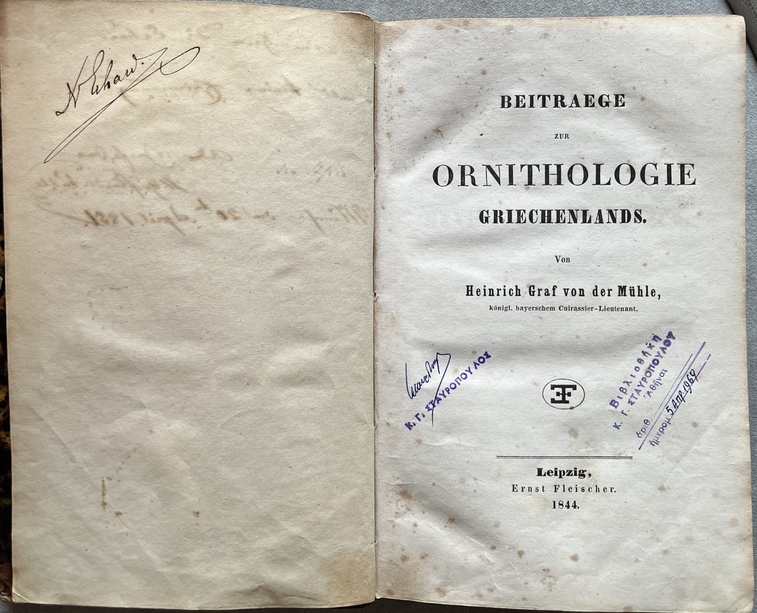
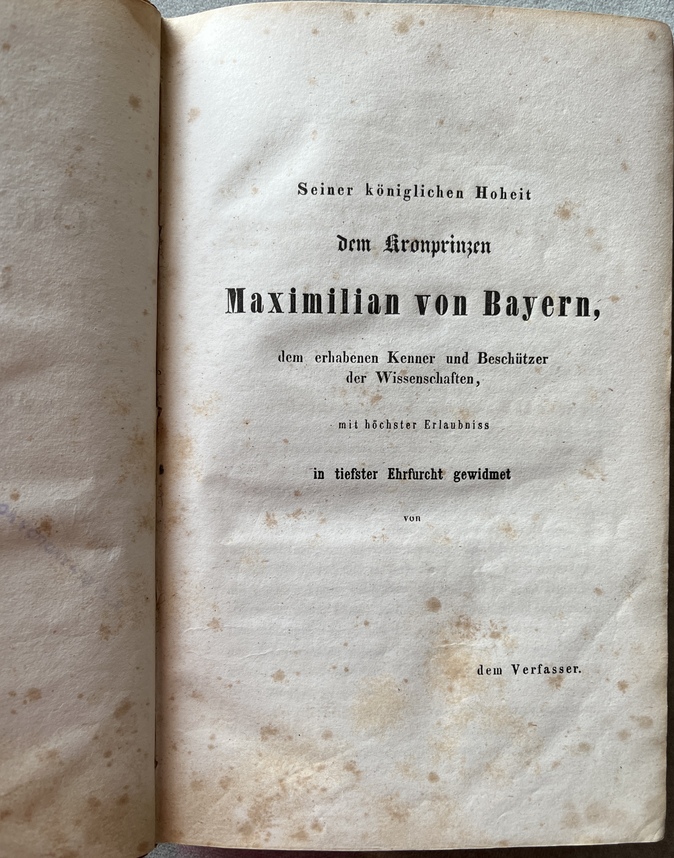
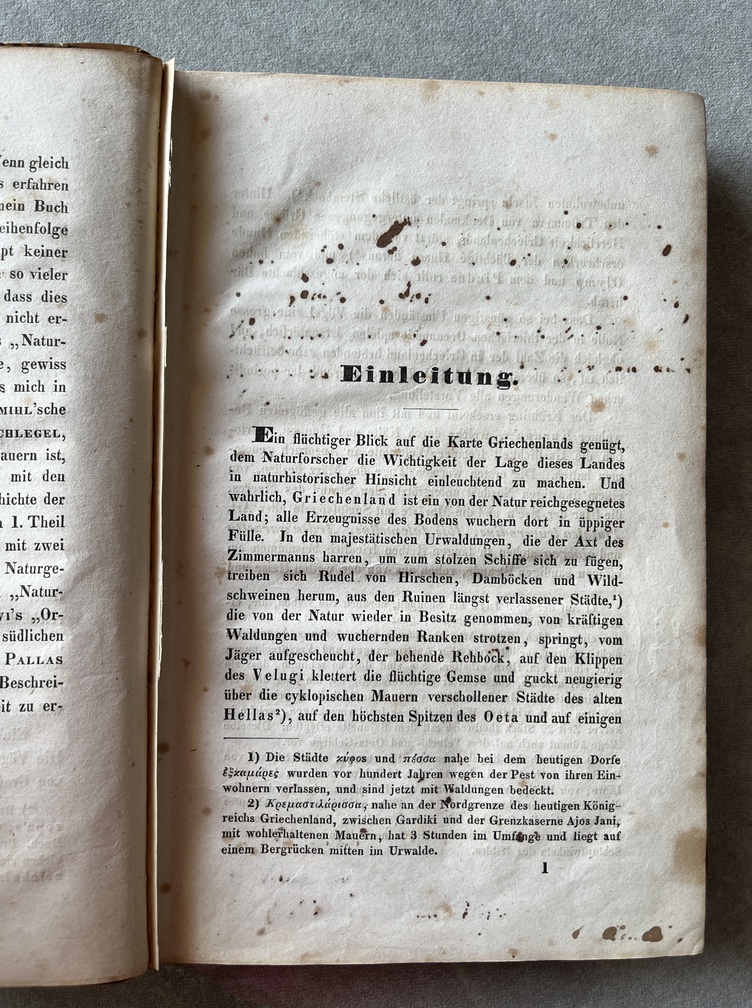
An extraordinary surviving copy of the first edition of Heinrich Karl Leopold Graf von der Mühle’s Beiträge zur Ornithologie Griechenlands, published in Leipzig by Ernst Fleischer in 1844.
The book is important in its own right as an early systematic contribution to the ornithology of Greece. Von der Mühle, a Bavarian officer and naturalist, conducted extensive observations and collecting in Greece during his residence there. Contemporary scientific literature praised the work for its careful observations, discussion of species and habits, and recorded 321 species of Greek birds.
This particular copy, however, is of exceptional interest because of its direct personal association with Dr. Erhard.
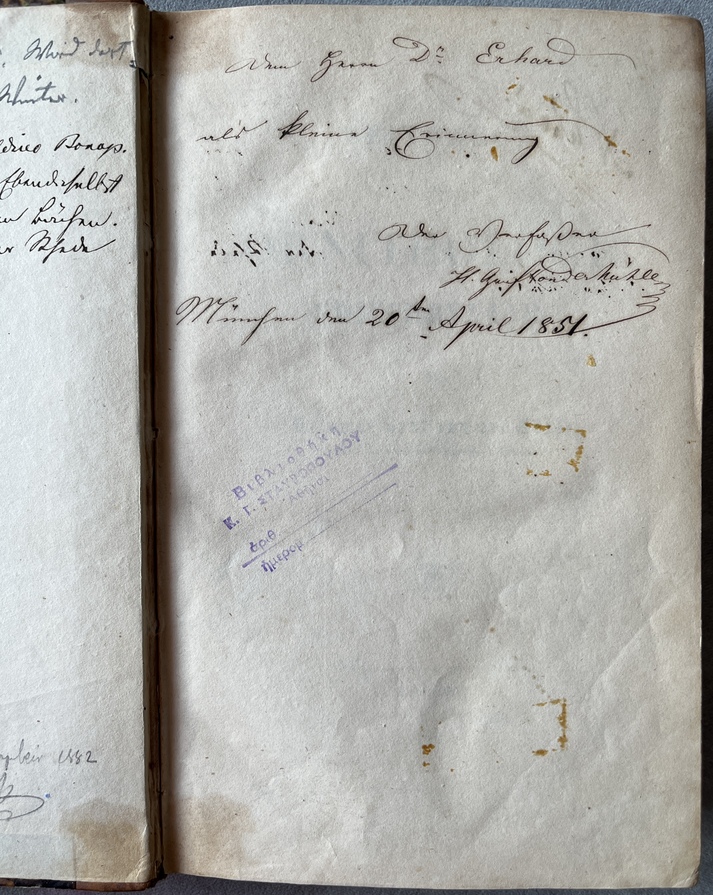
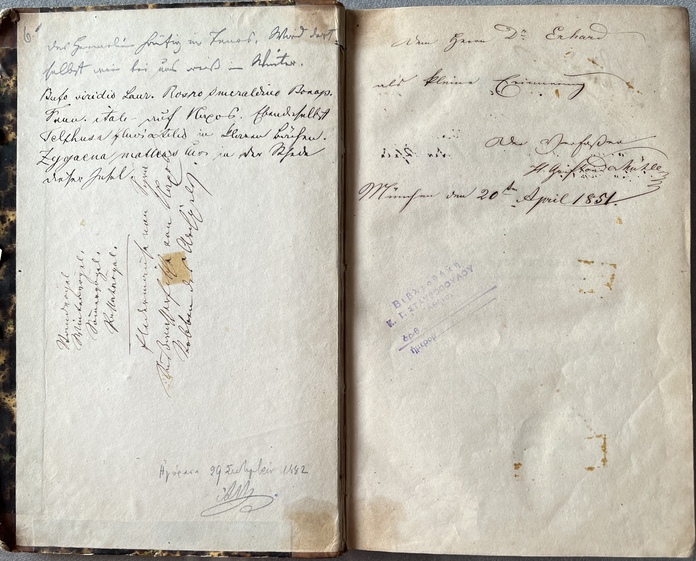
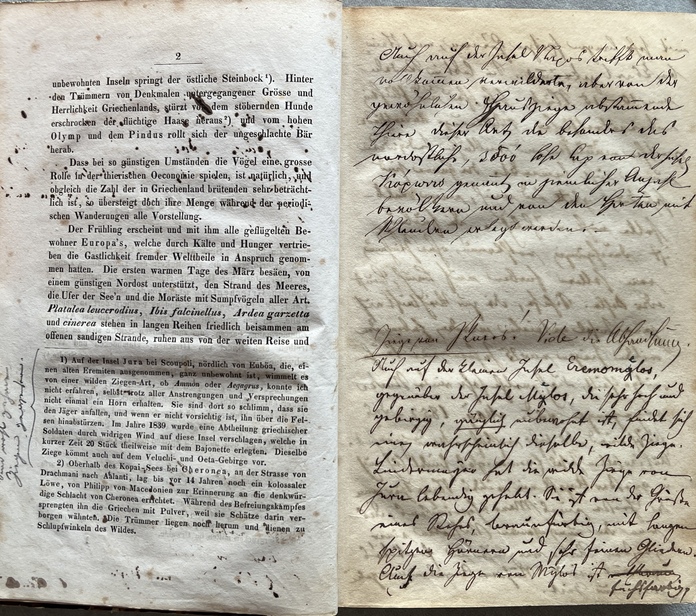
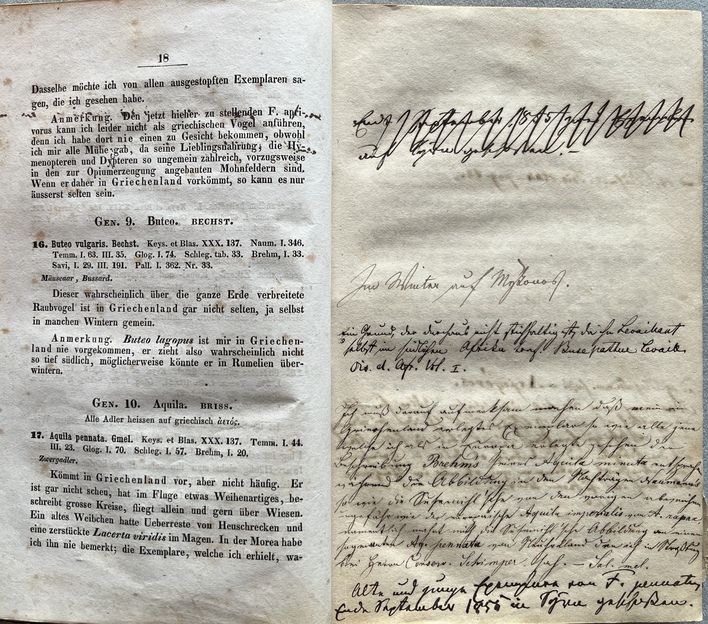
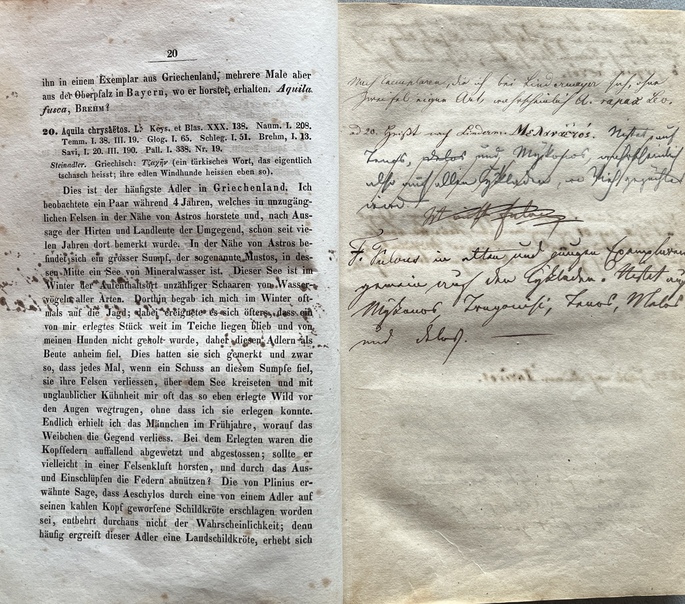
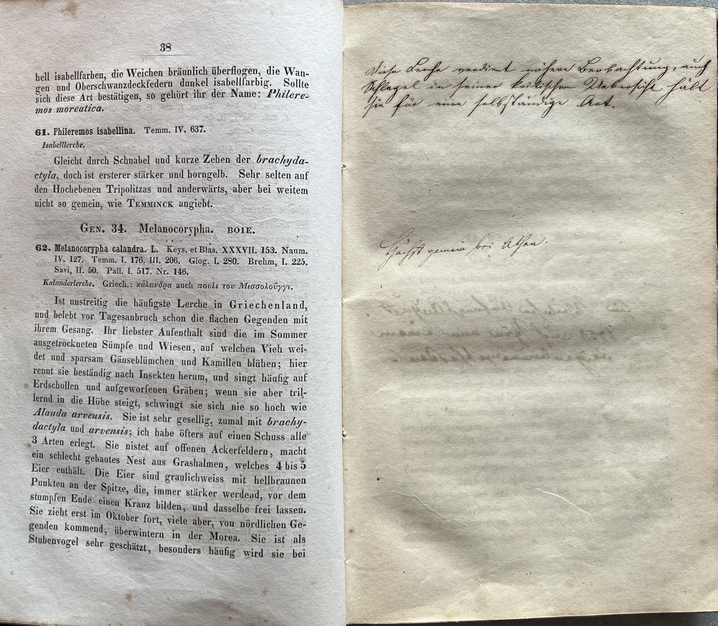
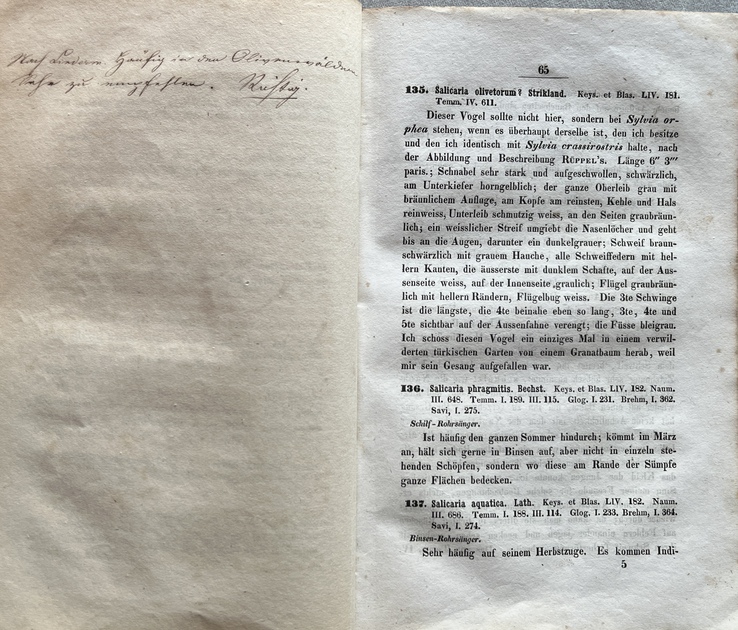
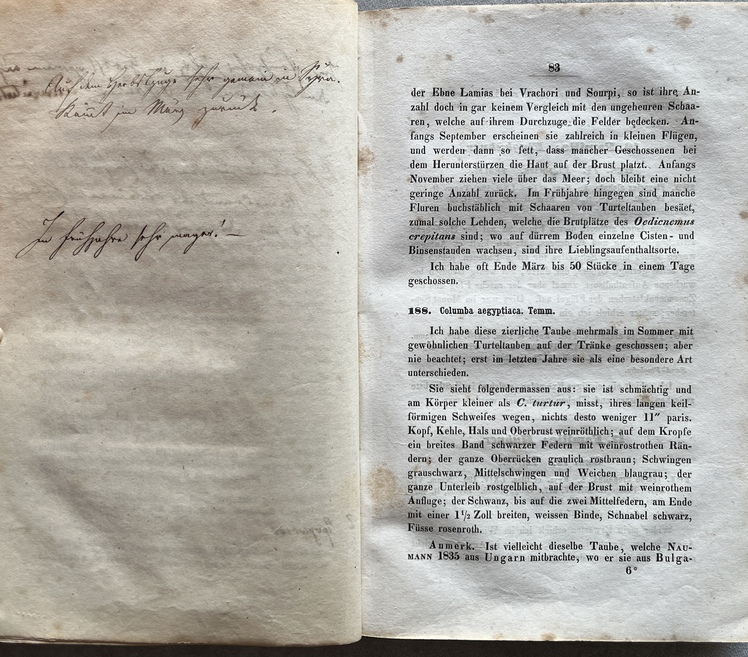
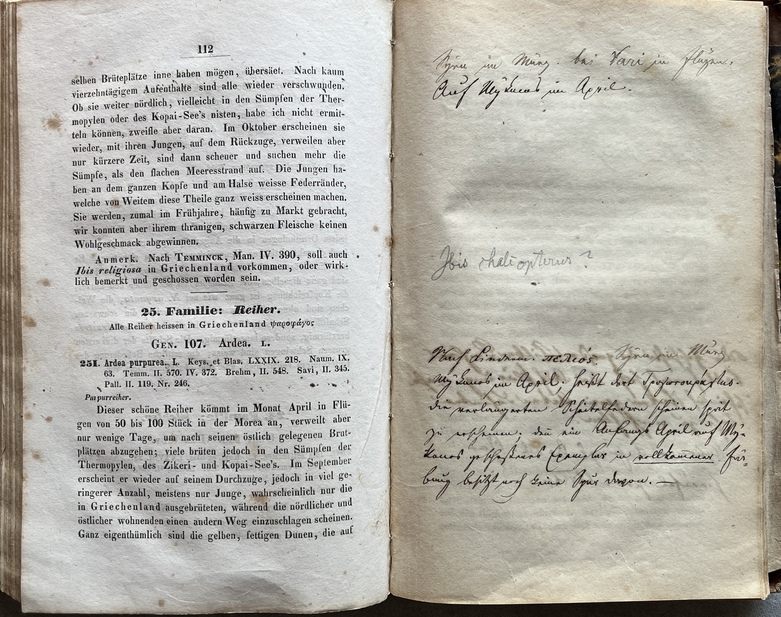
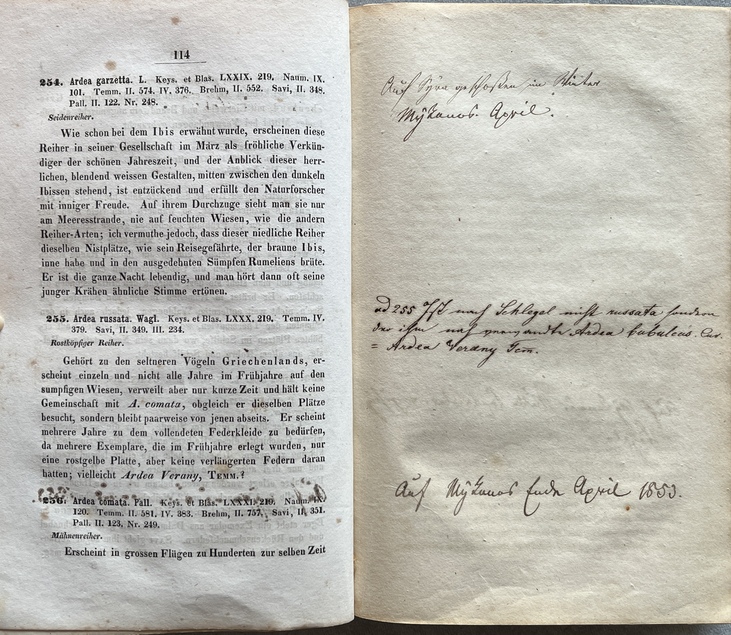
The volume was personally presented by von der Mühle to Dr. Erhard in Munich on 20 April 1851, as recorded in the author’s autograph dedication. It subsequently became a heavily used scientific working copy, specially bound with 70 interleaved blank leaves that were used for handwritten observations in nineteenth-century German Kurrent script.
The manuscript material transforms an already important first edition into a unique historical document: a book that records the transition from published ornithological knowledge to first-hand zoological observation in the Aegean.
On the front blank appears the author’s presentation inscription, dated:
München, den 20. April 1851
and addressed to:
Dr. Erhard
The inscription is signed:
H. Graf v. d. Mühle
The dedication establishes a direct personal connection between the author of this 1844 work and its subsequent scientific owner.
The timing is particularly significant. The volume passed into Erhard’s hands several years before the publication of his own important study of the Cyclades, Fauna der Cycladen, published in Leipzig in 1858.
The book can therefore be understood as an intellectual bridge between two generations of nineteenth-century German naturalists working in Greece.
The recipient is identified as Dr. Theodor Erhard, the German physician and naturalist associated with the scientific exploration of the Cyclades.
Erhard is principally remembered for his Fauna der Cycladen, published in Leipzig in 1858, an important nineteenth-century contribution to the zoology of the Aegean islands.
The present volume is particularly compelling because the manuscript observations are not generic marginalia. They concern precisely the kind of zoological and geographical subjects for which Erhard subsequently became known: the fauna, distribution and seasonal occurrence of animals in the Cyclades.
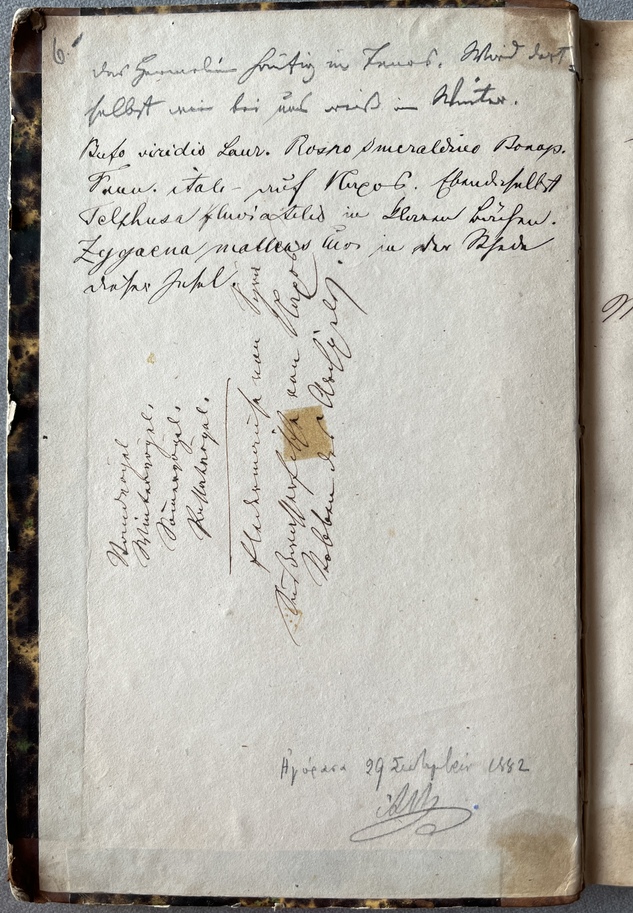
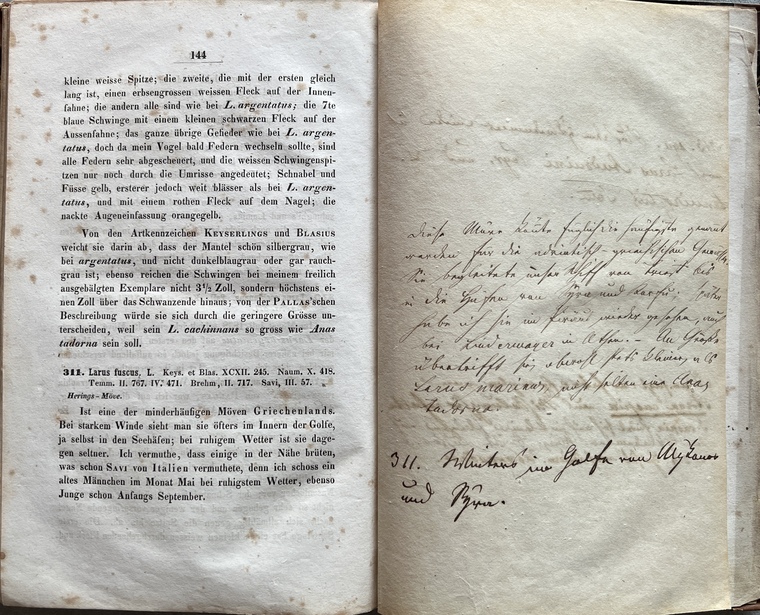
The most remarkable feature of the volume is the extensive manuscript material on its interleaved blank leaves.
Erhard used the book as a scientific working notebook, recording observations concerning birds, amphibians, reptiles, crustaceans and marine animals.
The handwriting is predominantly nineteenth-century German Kurrent, accompanied by Latin scientific names and occasional Greek.
The notes include observations concerning:
Among the recorded organisms are Bufo viridis, Telphusa fluviatilis and Zygaena malleus, together with numerous birds classified according to their seasonal occurrence.
One particularly revealing passage divides birds into categories corresponding to resident birds, partial migrants, migratory birds and resting/passage birds, accompanied by references to their occurrence on Syros and Naxos.
These observations provide a fascinating insight into the working methods of nineteenth-century field zoology, when distribution, migration, breeding and specimen collecting were established through direct observation and comparison with published authorities.
The notes relating to Naxos are of particular interest.
Erhard records amphibians and freshwater fauna, including observations of Bufo viridis and Telphusa fluviatilis, as well as marine observations including the nineteenth-century zoological name Zygaena malleus for the hammerhead shark.
The manuscript thus extends considerably beyond ornithology and documents the broader natural history of the Cycladic islands.
The combination of precise localities, zoological nomenclature and field observations gives the manuscript considerable potential importance for historians of Mediterranean zoology and island biogeography.
Another particularly unusual section concerns the wild goats (Aegagrus) of Antimilos (Eremomilos), the isolated volcanic island near Milos.
The notes preserve observations concerning this distinctive island population and provide a nineteenth-century naturalist’s account of an isolated Mediterranean ecosystem.
Such observations are especially valuable because nineteenth-century field notebooks of this type are considerably scarcer than published zoological works.
The manuscript also refers to Anton Lindermayer, the Bavarian physician and naturalist who worked in Greece.
Lindermayer’s Die Vögel Griechenlands: Ein Beitrag zur Fauna dieses Landes was published at Passau in 1860 and comprised 188 pages.
His work formed part of the rapidly developing scientific literature on Greek birds, alongside von der Mühle’s earlier 1844 contribution. Contemporary zoological reporting explicitly discusses the two works together and compares their species records.
The references to Lindermayer in Erhard’s manuscript are consequently of considerable interest: they appear to show the process by which naturalists working in Greece compared published records with observations made directly in the field.
The volume continued to have a life in Greece long after its original presentation.
A later manuscript entry in Greek is dated 29 September 1882, providing evidence of subsequent ownership or purchase.
The book also bears the purple stamp of the private library of K. G. Stavropoulos, Athens.
The provenance therefore preserves a remarkable sequence:
Heinrich Graf von der Mühle → Dr. Erhard → later Greek ownership → K. G. Stavropoulos, Athens
This gives the volume an unusually strong connection with the intellectual and scientific history of nineteenth-century Greece.
The manuscript is not confined to zoology.
Erhard also recorded historical and archaeological observations concerning Greece, including material relating to the Lion of Chaeronea and events surrounding its destruction during the Greek War of Independence.
The volume consequently functions as a broader personal record of nineteenth-century Greece, combining natural history, geography, archaeology and historical observation.
Heinrich Karl Leopold Graf von der Mühle (1810–1855) was a Bavarian military officer and naturalist.
During his residence in Greece he devoted considerable time to collecting and studying birds. A contemporary zoological review of the 1844 book describes him as having worked industriously on the indigenous birds of Greece and praises his observations and knowledge of the relevant literature. The book listed 321 species.
His Beiträge zur Ornithologie Griechenlands remains an important early source for the ornithology of the newly established Greek state.
The work is bibliographically recorded as:
Leipzig: Ernst Fleischer, 1844.
The significance of the present volume rests upon the combination of:
• First edition of an important early work on Greek ornithology.
• Personal presentation by the author, Heinrich Graf von der Mühle, to Dr. Erhard in Munich on 20 April 1851.
• Extensive original manuscript observations by the recipient.
• Detailed observations of the fauna and bird life of the Cyclades.
• References to Naxos, Syros and other Aegean localities.
• References to Anton Lindermayer and the developing scientific literature on Greek birds.
• Zoological observations extending beyond ornithology to amphibians, reptiles, crustaceans and marine fauna.
• Observations concerning the wild goats of Antimilos.
It is therefore much more than a rare first edition. It is a surviving scientific association copy and working field notebook documenting the development of nineteenth-century natural-history research in Greece.
Author: Heinrich Karl Leopold Graf von der Mühle
Title: Beiträge zur Ornithologie Griechenlands
Publisher: Ernst Fleischer
Place: Leipzig
Date: 1844
Edition: First edition
Language: German, Greek, Latin
Format: Octavo, approx. 21 cm × 14 cm
Pages: VIII + 148 + 140
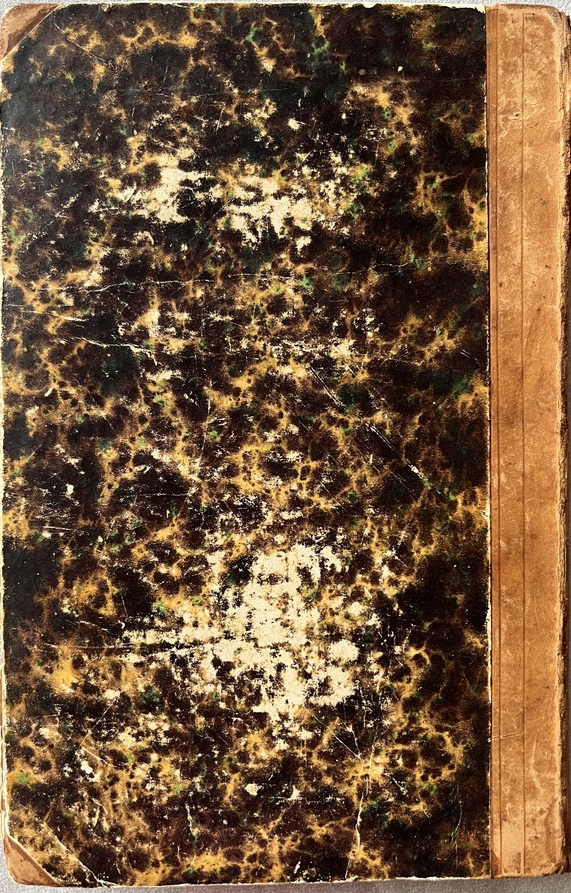
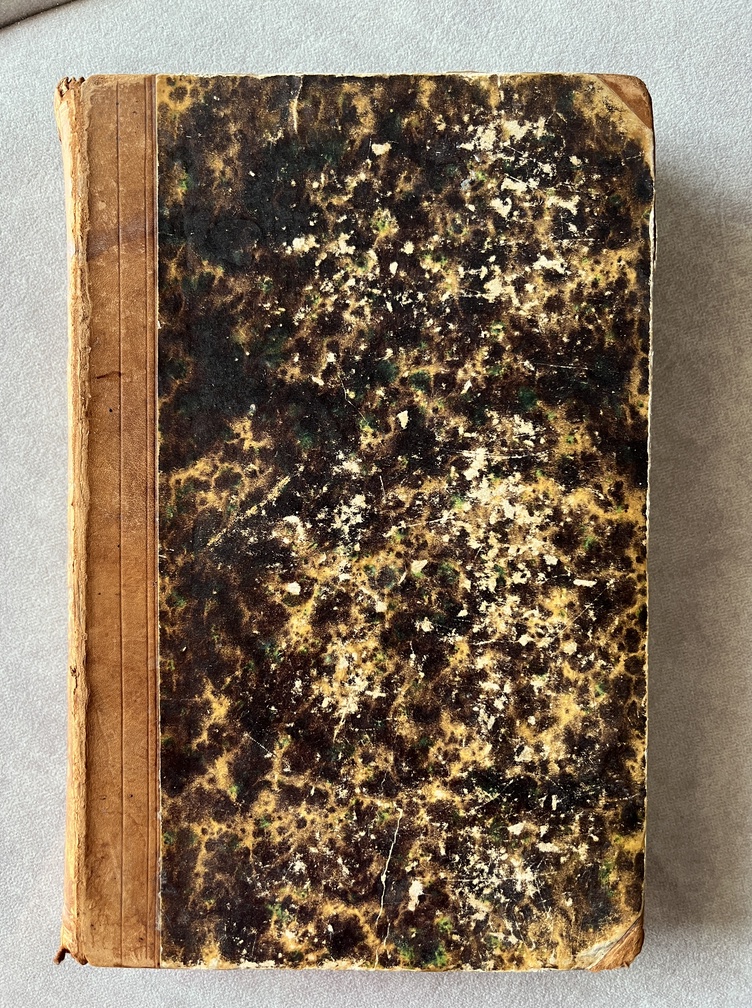
Binding: Contemporary half-leather over marbled boards
Special feature: Interleaved blank leaves containing extensive original manuscript annotations
Manuscript: German Kurrent, Latin scientific nomenclature and occasional Greek
Provenance: Heinrich Graf von der Mühle; Dr. Theodor Erhard; later Greek ownership; K. G. Stavropoulos, Athens
Condition: Good to very good
The contemporary binding remains structurally sound, with the expected rubbing to the leather, edges and corners.
The textblock is complete. The paper displays normal age toning with occasional foxing and staining consistent with a nineteenth-century working volume.
The manuscript leaves are remarkably well preserved. The ink is generally dark and the handwriting remains legible.
Given the volume’s prolonged use as a scientific notebook, its condition is very good and the survival of such extensive original manuscript material is exceptional.
Please examine all photographs carefully, as they form an integral part of the description.