850.00€
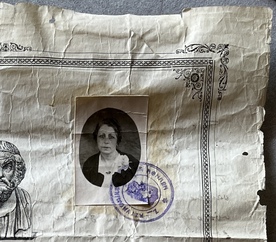
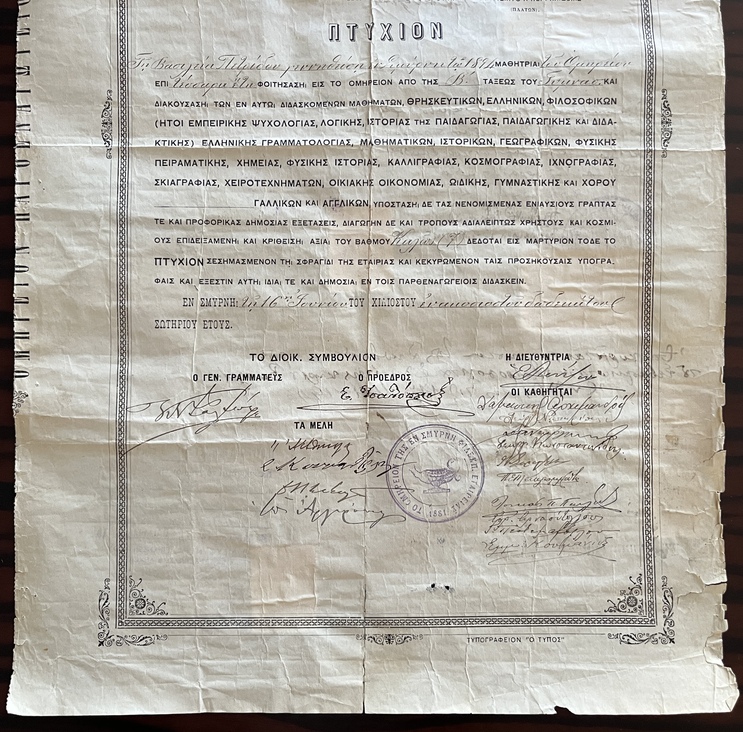
A rare and historically significant 1912 diploma from the Homerion (Omireion) Higher Greek Girls’ School of Smyrna, preserved complete with an extraordinary series of post-war Greek legalization annotations, official seals, signatures and revenue stamps dating from May 1946.
This remarkable document connects three distinct historical moments: the flourishing of the Greek community of Smyrna before 1922, the survival of an educational credential through the catastrophe and displacement of the Greek population of Asia Minor, and its subsequent legal recognition by the Greek authorities in Athens in 1946.
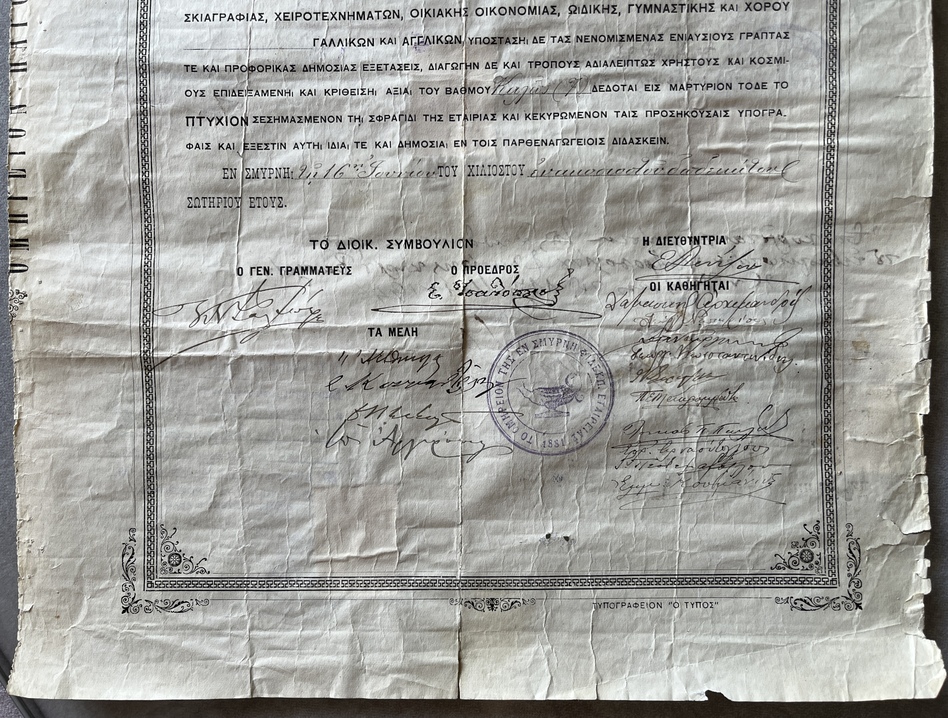
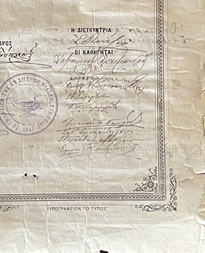
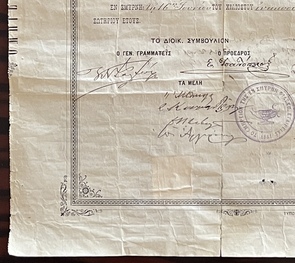
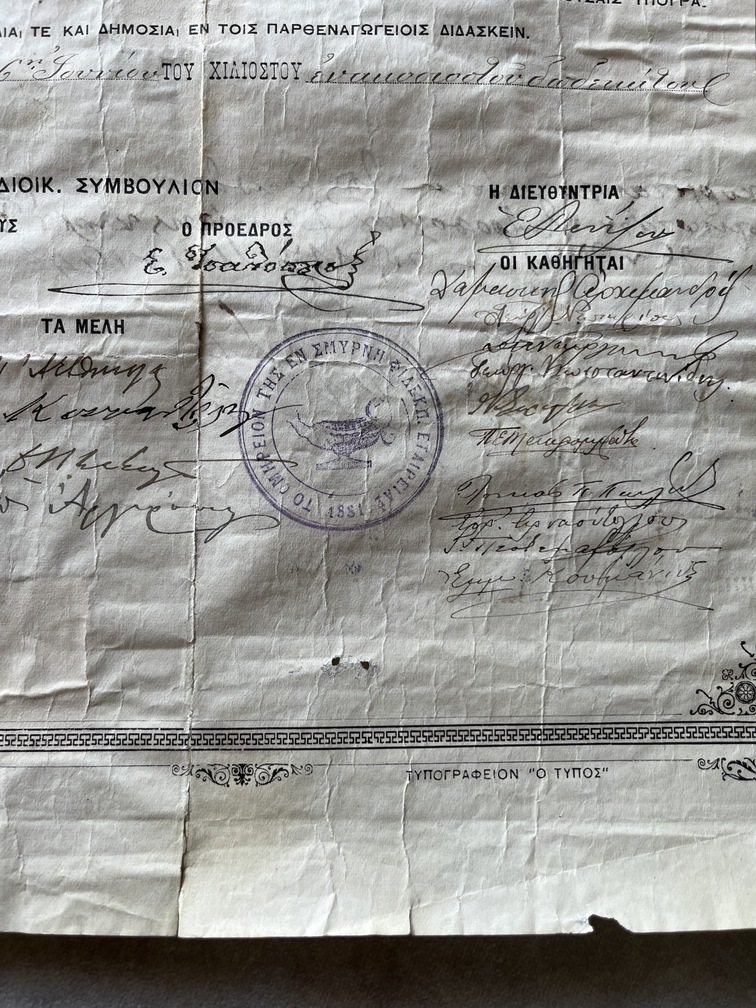
The diploma was issued on 16 June 1912 to Vassiliki Petridou by the Homerion Girls’ School of Smyrna. Particularly significant is the signature of Eleni Louizou, the school’s director, who remained its director until the destruction of the institution in 1922.
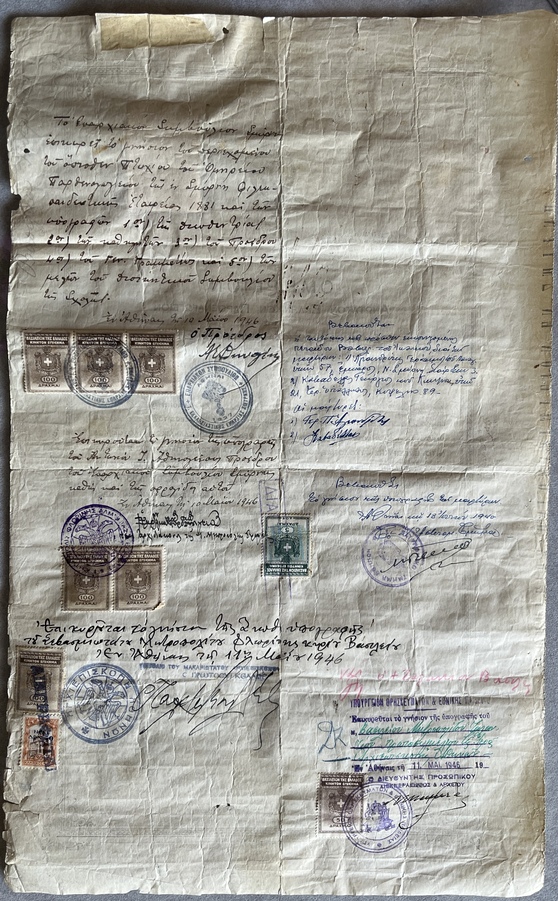
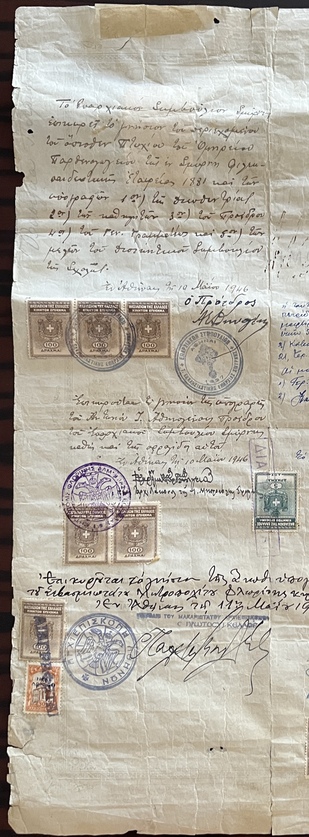
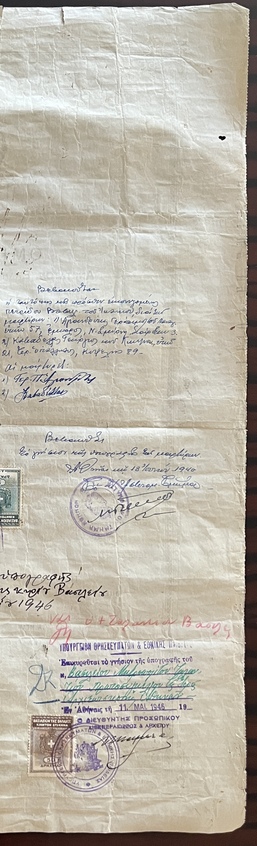
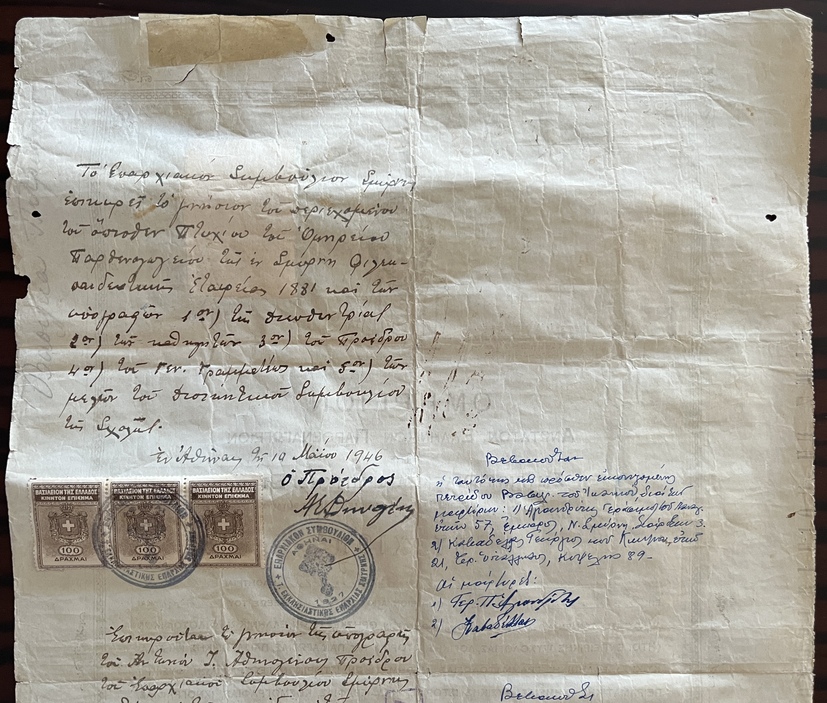
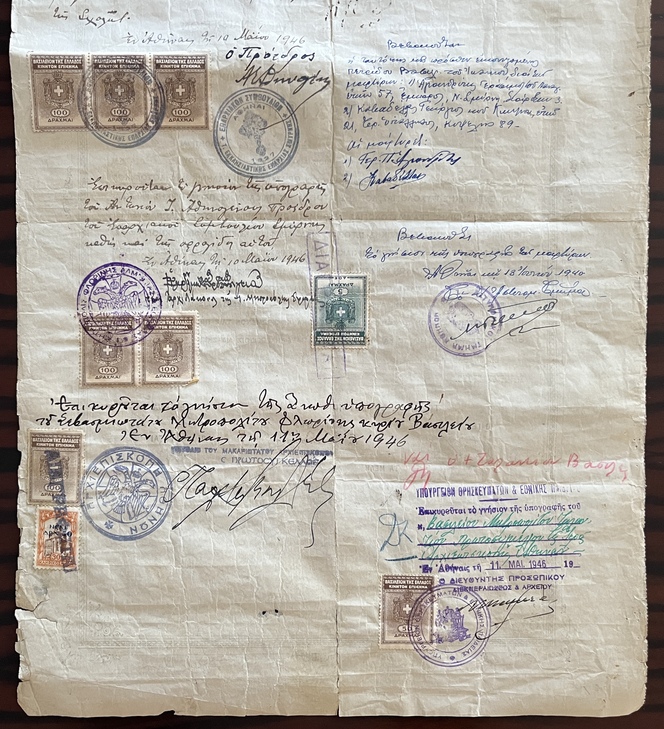
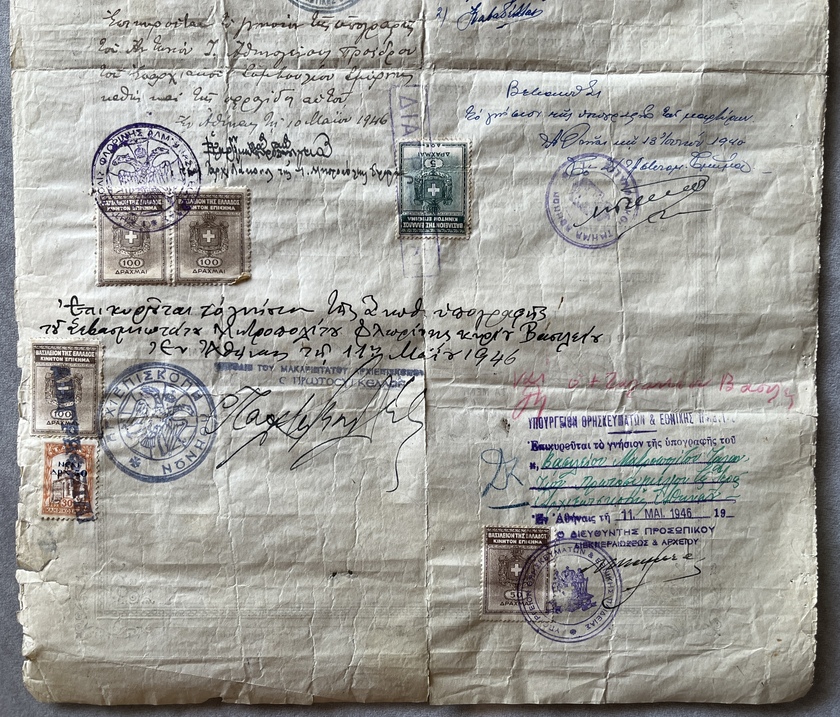
The reverse of the diploma preserves an exceptional administrative record documenting its later legalization in Greece. The handwritten declarations, official seals, signatures and revenue stamps were applied in Athens during May 1946, more than three decades after the original diploma was issued.
The Homerion (Omireion) Parthenagogeion was founded in Smyrna in 1881 by the Philekpaideftiki Etaireia Smyrnis (Educational Society of Smyrna), on the initiative of Pavlos Athinogenis and Dionysios Markopoulos.
Initially known as the Greek Girls’ School of Smyrna, it adopted the name Homerion in 1886, in honour of Homer and the ancient city of Smyrna traditionally associated with the poet.
The school developed into one of the leading Greek educational institutions for girls in Smyrna. It included higher education and teacher training and was regarded as an institution of considerable standing within the Greek educational world of the Ottoman Empire.
By 1920 it had approximately 250 students, 11 professors and 11 teachers, together with a substantial library. Contemporary accounts describe an extensive curriculum including Greek, French, English, German, Italian and Armenian, as well as literature, philosophy, mathematics, history, geography, science, music, physical education and other subjects.
The school’s director until 1922 was Eleni Louizou, whose signature appears on the present diploma.
The school building was destroyed during the Catastrophe of Smyrna in September 1922, bringing the institution’s existence in the city to an end. The historical record of the school has subsequently been reconstructed from archival and documentary sources, including material held in Greek archives.
Student: Vaasiliki Petridou
Institution: Homerion Higher Greek Girls’ School, Smyrna
Date of issue: 16 June 1912
Place: Smyrna, Ottoman Empire
Document type: Diploma / Ptychio
Language: Greek
The diploma is preserved as a complete original document, rather than merely as a detached certificate fragment.
Of particular importance is the surviving signature of Eleni Louizou, the long-serving director of the Homerion, providing a direct connection between the document and the school’s administration in Smyrna before 1922.
The reverse of the diploma is particularly fascinating.
Following the upheavals of the First and Second World Wars, the Asia Minor Catastrophe and the displacement of the Greek population of Smyrna, original educational credentials from Asia Minor could become important evidence of an individual’s educational history and qualifications.
The reverse of this diploma documents its subsequent legal verification in Athens in May 1946.
The administrative additions include:
The upper portion contains handwritten declarations and verification relating to the original diploma, recording its issuance and validity.
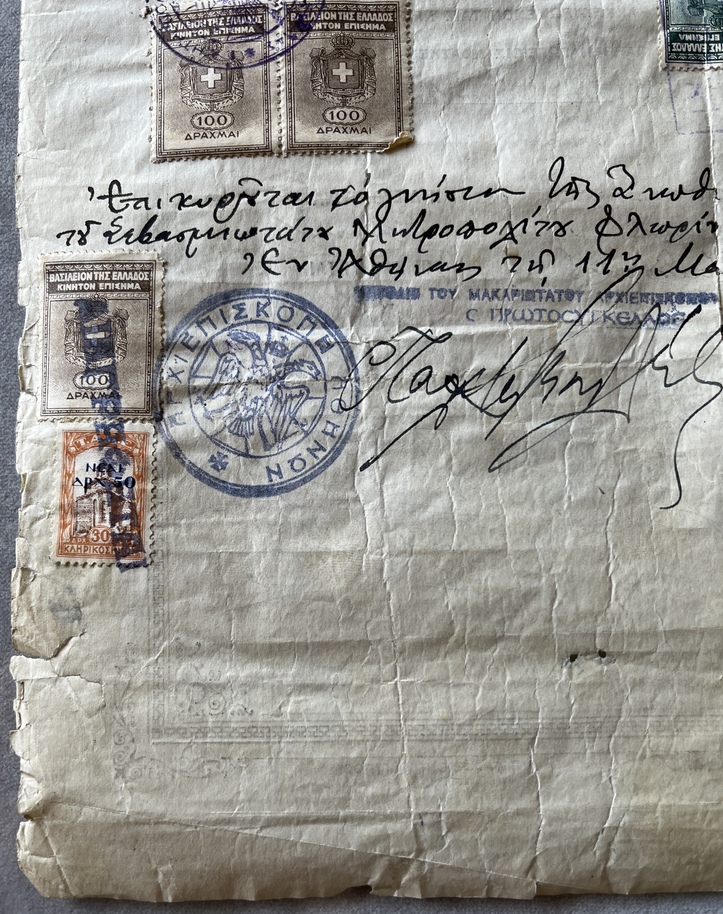
The document is heavily franked with genuine mid-twentieth-century Greek revenue stamps (χαρτόσημο / hartosimo), including:
The stamps remain physically attached to the document and are tied by official cancellations.
The reverse bears multiple official circular ink stamps and seals from the authorities involved in the legalization process, including the Greek Ministry of Education and Religious Affairs (Υπουργείον Θρησκευμάτων & Εθνικής Παιδείας).
The administrative process was finalized on 31 May 1946.
Multiple handwritten signatures appear alongside the official endorsements, recording the participation of contemporary administrative officials, committee members and ministerial clerks.
Together, these elements transform the reverse from a simple endorsement into a fascinating 1946 administrative record in its own right.
The exceptional interest of this document lies in the fact that it survived the destruction of Smyrna and subsequently passed through the Greek state’s post-war administrative system.
It is therefore simultaneously:
A pre-1922 Greek-Ottoman educational document
A diploma from one of Smyrna’s most important girls’ schools
A document bearing the signature of its long-serving director
A survivor of the destruction of Smyrna
A post-war Greek administrative and legal record
A remarkable example of the continued importance of Asia Minor documents to displaced Greek communities
The survival of original school diplomas is particularly significant in the context of the destruction and dispersal of the institutions of Greek Smyrna in 1922. The modern scholarly literature on the Homerion specifically draws upon archival material to reconstruct the school’s history and its relationship with Greek education and the Greek state.
This diploma therefore has considerable appeal not only to collectors of historical documents, but also to those interested in Asia Minor Hellenism, the Greek community of Smyrna, women’s education, Ottoman history, refugee history and the history of education.
Antique / vintage, with authentic signs of age and historical use.
Large-format document measuring approximately 47 cm × 29 cm.
The paper displays attractive and entirely natural age characteristics, including:
The handwritten text and signatures remain clear, sharp and legible.
The revenue stamps are exceptionally well preserved for their age and remain firmly attached to the document. The numerous official cancellations and seals are also clearly visible.
The folds and signs of handling should be regarded as part of the document’s history rather than as defects diminishing its documentary character.
Please examine all photographs carefully, as they form an integral part of the condition report.
Document: Diploma (Ptychio)
Institution: Homerion / Omireion Higher Greek Girls’ School
Place: Smyrna, Ottoman Empire
Date of original diploma: 16 June 1912
Student: Vaasiliki Petridou
Director: Eleni Louizou
Later legalization: Athens, May 1946
Final official date visible: 31 May 1946
Language: Greek
Dimensions: approximately 47 cm × 29 cm
Revenue stamps: Greek hartosimo, including 100- and 5-drachma denominations
Document type: Original educational diploma with later official endorsements, seals, signatures and revenue stamps
This is far more than an old school certificate.
It is a surviving primary document from the Greek educational world of Smyrna before 1922, bearing the name and signature of the institution’s director and subsequently carrying a remarkable documentary trail created in Athens in 1946.
The combination of the 1912 diploma and the extensive 1946 legalization record makes this an unusually rich historical object. It preserves, on a single sheet, evidence of the life of a Greek educational institution in Ottoman Smyrna and its later administrative afterlife in post-war Greece.
An exceptional document for collectors and institutions interested in:
A remarkable and highly evocative survivor from the vanished Greek educational world of Smyrna before 1922, with an extraordinary second life documented by the official Greek legalization process of 1946.