
Rare 1925 Greek-Turkish Population Exchange – Complete 8-Page Property Dossier
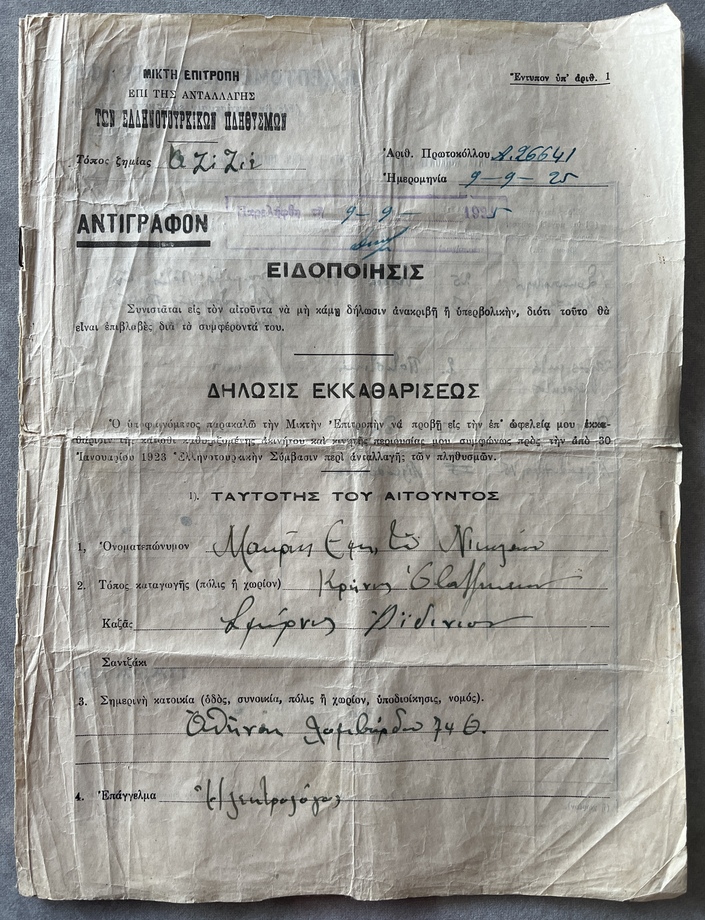
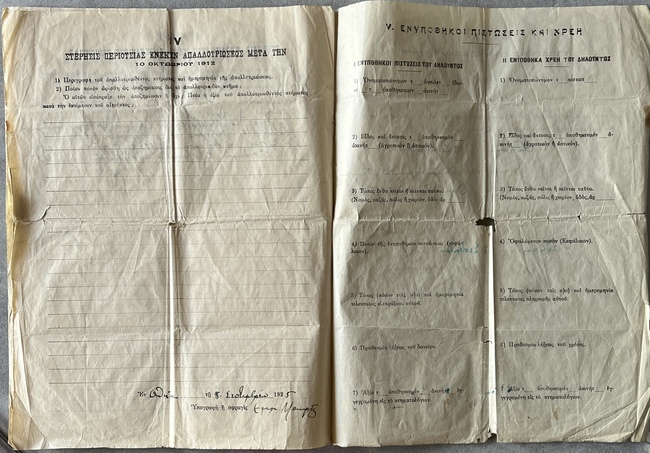
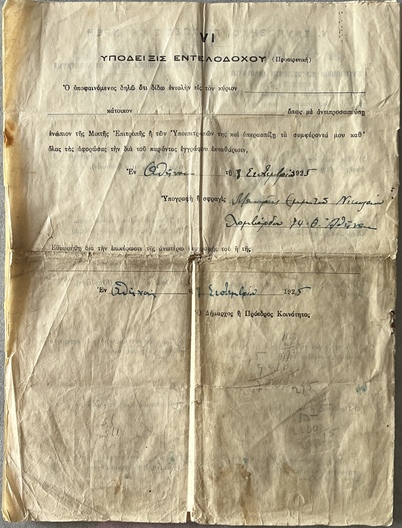
A remarkable and highly collectible original 8-page administrative dossier dating from 9 September 1925, relating to the compulsory population exchange between Greece and Turkey following the Treaty of Lausanne.
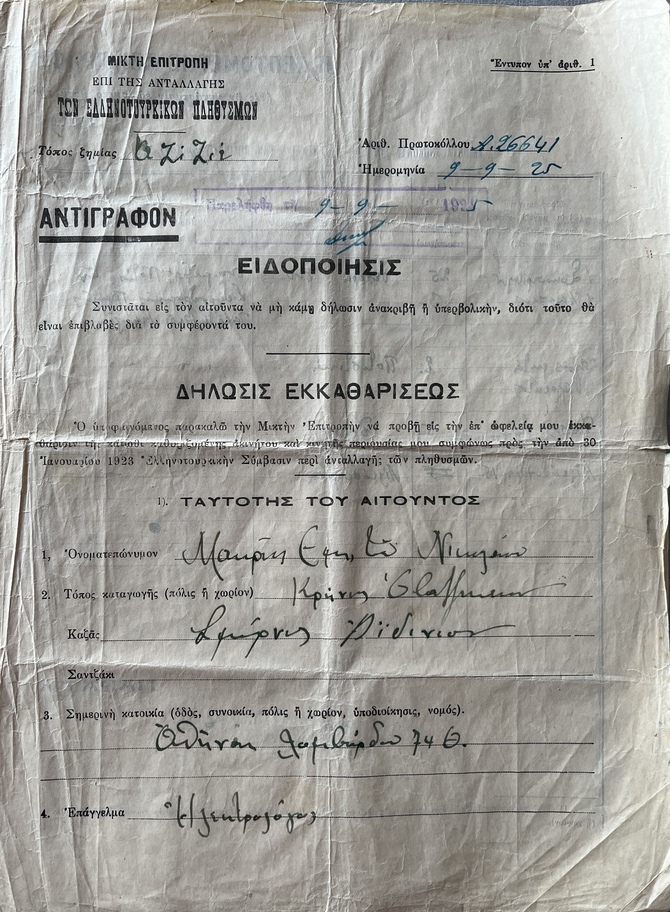
The document was issued by the Mixed Commission for the Exchange of Greek and Turkish Populations (Μικτή Επιτροπή επί της Ανταλλαγής των Ελληνοτουρκικών Πληθυσμών) and concerns the declaration and liquidation of immovable property belonging to a Greek refugee who had left Asia Minor following the population exchange.
Unlike the much more commonly encountered single-page certificates, receipts or refugee identification documents, this is a substantial, fully completed eight-page record, containing detailed handwritten information concerning the applicant, his former place of residence, property and other assets left behind.
Historical background
The 1923 Greek–Turkish population exchange, agreed as part of the Lausanne settlement, resulted in the compulsory relocation of approximately 1.5 million Orthodox Christians from Turkey and several hundred thousand Muslims from Greece.
Documents such as this provide an unusually direct connection with the practical and bureaucratic consequences of the exchange. They record not merely the movement of a refugee, but the property and possessions left behind and the subsequent administrative process for documenting and settling those claims.
Details recorded in this dossier
The document is dated:
9 September 1925
It identifies the applicant as:
Emmanouil Makris, son of Nikolaos (Εμμανουήλ Μακρής του Νικολάου)
Occupation: Electrician (Ηλεκτρολόγος)
Former place of origin: Krini / Çeşme (Κρήνη / Τσεσμέ)
Administrative district: Kaza of Smyrna / İzmir, Aidin Vilayet
Post-exchange residence: Athens, Greece
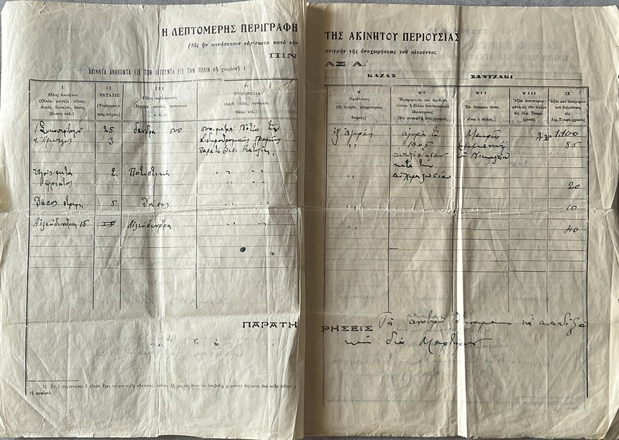
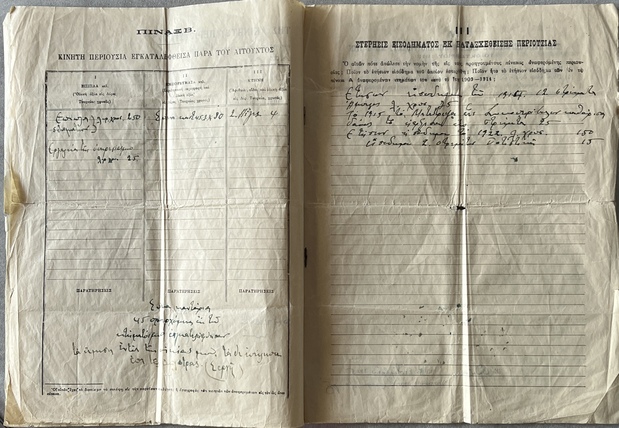
The pages contain extensive handwritten entries relating to the applicant’s immovable property, including houses, land and associated details. The dossier also contains tabulated information concerning the property and its valuation/settlement, providing a fascinating glimpse into the administrative mechanisms used to deal with property abandoned during the population exchange.
The handwriting is exceptionally interesting in its own right: the document has been extensively completed in contemporary handwritten Greek, preserving the personal and bureaucratic record almost exactly as it was created a century ago.
Physical characteristics
Date: 9 September 1925
Issuing authority: Mixed Commission for the Exchange of Greek and Turkish Populations
Document type: Declaration of Settlement / Liquidation (Δήλωσις Εκκαθαρίσεως)
Format: Complete 8-page administrative dossier/booklet
Approximate dimensions: 31 cm × 24 cm
Language: Greek, with printed administrative text and extensive handwritten entries
Subject: Greek–Turkish Population Exchange, Asia Minor refugees, abandoned property, Smyrna/İzmir region
Applicant: Emmanouil Makris of Nikolaos
Former residence/origin: Krini / Çeşme, Smyrna district
New residence: Athens, Greece
This is an unusually evocative piece of primary-source documentation relating to the 1923 population exchange. Its importance lies particularly in the combination of:
an identifiable refugee;
a specific locality in Asia Minor;
a precise post-exchange address in Athens;
detailed information concerning abandoned property;
extensive contemporary handwriting;
and a complete multi-page administrative record.
It would be of considerable interest to collectors of Greek history, Asia Minor and Smyrna/İzmir history, refugee studies, the Treaty of Lausanne, Greek–Turkish relations, genealogy, historical documents and antiquarian ephemera.
The document also has considerable research potential: the named individual, locality, property information and Athens address provide multiple avenues for further historical or genealogical investigation.
Condition
Very good antique condition considering its age and original administrative use.
The paper has natural age toning and numerous folds/creases from historical handling and storage, with some general surface wear. Despite this, the document retains its structural integrity, remains complete and the handwritten entries are clearly legible throughout.
Please examine the photographs carefully, as they form an integral part of the condition description.
An exceptionally interesting and unusually complete primary document from the aftermath of the 1923 Greek–Turkish population exchange — preserved in the form of a detailed, fully completed eight-page property record from 1925.