
365.00€
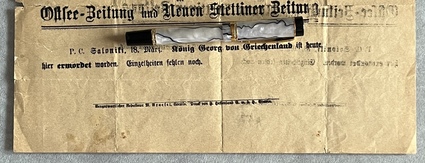
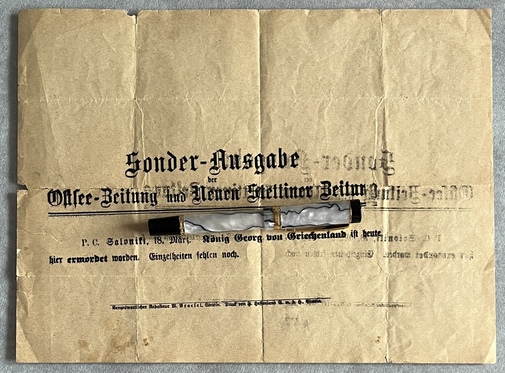
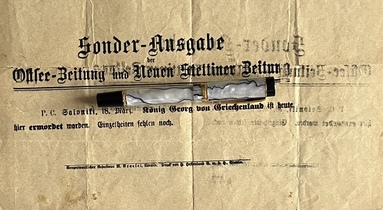
Exceptional original German Sonder-Ausgabe (Special Edition) reporting the assassination of King George I of Greece in Saloniki (Thessaloniki) on 18 March 1913.
A remarkable piece of original European historical ephemera, issued on the very day that King George I was assassinated during the First Balkan War.
This rare single-sheet emergency newspaper bulletin was published in Stettin, German Empire (today Szczecin, Poland) by the Ostsee-Zeitung und Neue Stettiner Zeitung.
Rather than being a later retrospective article, this is a contemporary breaking-news publication, produced while information about the assassination was still arriving.
The historical immediacy of the sheet is captured perfectly by the wording of the report:
“Einzelheiten fehlen noch.”
“Details are still missing.”
The principal report is printed in dramatic German Fraktur (blackletter) and reads:
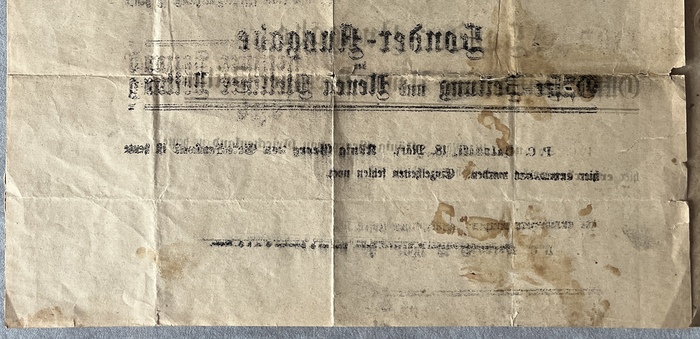
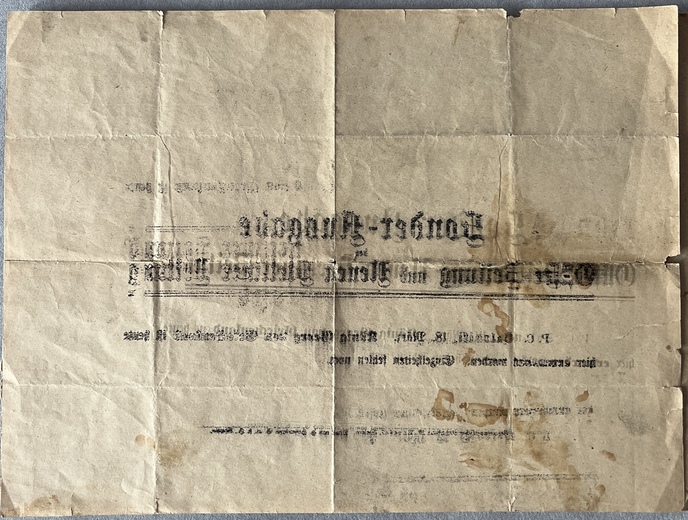
“P.C. Saloniki, 18. März. König Georg von Griechenland ist heute hier ermordet worden. Einzelheiten fehlen noch.”
Translation:
“P.C. Saloniki, 18 March. King George of Greece was assassinated here today. Details are still missing.”
The abbreviation “P.C.” appears to identify the press/news source or transmission point of the Saloniki dispatch, although its precise contemporary expansion has not been established.
The wording provides a fascinating glimpse into the mechanics of international journalism in the early twentieth century. News travelled by telegraph and press agencies, and special editions could be rushed into print when an event was considered too important to wait for the next regular newspaper issue.
The statement that details were still missing makes this sheet particularly compelling: it preserves the news at the moment when the event was still unfolding within the international information network.
The large heading:
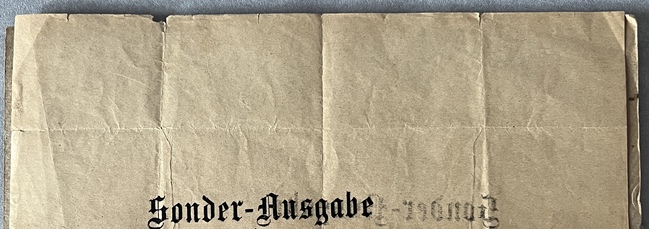
SONDER-AUSGABE
identifies the sheet as a special/emergency edition.
The masthead reads:
“der Ostsee-Zeitung und Neuen Stettiner Zeitung”
The publication was one of the established newspapers of Stettin, the important Pomeranian city that is now Szczecin, Poland.
The sheet identifies M. Braesel, Stettin, as the responsible editor (Verantwortlicher Redakteur).
King George I (1845–1913) had been King of Greece since 1863 and had ruled for almost half a century.
His assassination occurred during the First Balkan War, at a moment of enormous importance for Greece and the Balkans.
Thessaloniki had recently been captured by Greek forces from the Ottoman Empire. King George subsequently went to the city and remained there during the following months, reinforcing the political significance of the Greek presence in the newly acquired territory.
On 18 March 1913, while walking near the White Tower, the King was approached and shot by Alexandros Schinas.
He died shortly afterwards.
The assassination shocked Europe and was immediately reported by newspapers across the continent and beyond.
King George’s death was followed by the accession of his eldest son, Constantine I, to the Greek throne.
The geographical context gives this newspaper bulletin exceptional historical importance.
During the First Balkan War, Thessaloniki was one of the most strategically important cities in southeastern Europe. Greek forces captured the city in late 1912, shortly before the assassination.
The future of Macedonia and Thessaloniki was at the centre of intense political and military competition among the Balkan states.
The assassination therefore took place at one of the most consequential moments in the modern history of Greece and the Balkans.
This small sheet captures that history from the perspective of a German newspaper audience receiving the news in real time.
This item is best understood as primary-source historical ephemera, rather than simply an old newspaper.
It records:
The terse announcement and dramatic Fraktur typography give the sheet an unusually powerful visual and historical character.
For a collector, there is something particularly compelling about holding a document printed on the same day a European monarch was assassinated.
The Ostsee-Zeitung had a long history in Stettin.
Its origins go back to the Börsen-Nachrichten der Ost-See, first published in 1835 by the Stettin publishing firm F. Hessenland. The newspaper later became the Ostsee-Zeitung und Börsen-Nachrichten der Ostsee and, from 1905, the Ostsee-Zeitung und Neue Stettiner Zeitung, the title appearing on this 1913 issue.
The 1905–1922 title is bibliographically recorded as published in Stettin and printed by Stettiner Druckerei. The Hessenland connection is therefore best understood as part of the newspaper’s earlier publishing history rather than necessarily the printer of this particular 1913 sheet.
This provides an additional layer of interest for collectors of German newspaper history, Pomeranian printing and European journalism.
Condition
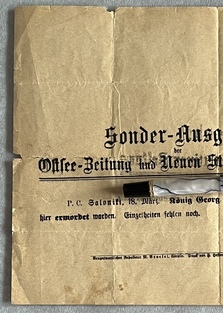
The sheet survives in authentic period condition, with a beautiful natural patina and the character expected of fragile newspaper paper more than a century old.
Condition includes:
The printing remains clearly legible, and the dramatic Fraktur typography and central announcement remain visually strong.
The historic folds are entirely consistent with the original handling and storage of a newspaper special edition and form part of the item’s history.
Please examine all photographs carefully, as they form an integral part of the condition description.
The fountain pen visible in the photographs is shown for scale only and is NOT included.
Approx. 31 cm × 23 cm
Approx. 12.2 × 9.1 inches
Format: Single-sheet special edition / emergency news bulletin
Language: German
Script: Fraktur / German blackletter
Date: 18 March 1913
Place of publication: Stettin, German Empire
Modern location: Szczecin, Poland
News dateline: Saloniki (Thessaloniki), 18 March 1913
Newspaper: Ostsee-Zeitung und Neue Stettiner Zeitung
Responsible editor: M. Braesel, Stettin